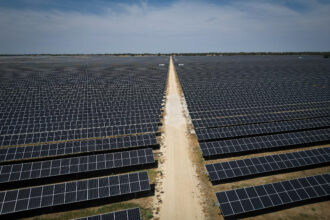
The solar efficiency problem may be solved, not by some amazing new material, but by existing and surprisingly cheap components.
Such were the findings of IBM researchers who recently achieved 9.6 percent efficiency with cells made from copper, tin, zinc, sulfur and/or selenium.
The efficiency of any solar cell refers to its photoelectric conversion rate; in other words, its ability to convert sunlight into electricity. While higher efficiency rates have been posted in the solar world (the highest so far is a 19.3 percent efficiency announced by Mitsubishi today), the IBM cell set a record for solar cells made with such low-cost and readily available materials.
Cells previously made with these materials achieved only 6.7 percent efficiency; the IBM cells were able to deliver higher efficiency because of the way the solar cells were fabricated.
Without getting overly technical, the gist of the IBM breakthrough is a new process that combines the best aspects of existing solar fabrication processes.
Solar cells are typically created via either the depositing of particles on a surface or the coating of a surface with a liquid solution (this includes cells, panels or films that are made by printing, coating, or spraying a solution).
Typically, cells made with Cu2ZnSn(S,Se)4 use the particle-based process, depositing particles onto surfaces via an expensive vacuum-based technique, but that hasn’t resulted in great efficiency, and using an expensive process to deposit low-cost materials isn’t a great solution. Researchers who have tried to take a liquid solution-based approach with the materials have had pretty dismal results (at most, a 1.6 percent efficiency).
The IBM breakthrough is a hybrid particle-solution approach that researchers say can be used with virtually any material (they used the copper-tin-zinc-sulfur/selenium mix as a pilot test-case because the materials are readily available and cheap).

The process is based on a slurry (or ink) made of Cu2ZnSn(S,Se)4 in hydrazine, which can then be coated on any PV device. The final solution is comprised of both solid particles and liquid, both of which contain metal and chalcogen elements, which are the key to higher efficiencies. Getting these elements into both particle and liquid forms helps integrate them further into the final film, which boosts efficiency.
The other benefit is that the solution can be applied via ultra high throughput printing or coating techniques, which means high-efficiency devices could be produced for low costs at a large scale: the holy grail for solar energy.
The highest-efficiency cells up to this point have been those made with indium, gallium or cadmium, but while those materials have managed to deliver stable power conversion efficiencies of over 9 percent, they are expensive and not available in abundance. Cadmium is also regulated as a heavy metal.
According to David Mitzi, who leads the team at IBM Research that developed the solar cell, the various problems associated with cadmium, indium and gallium are expected to restrict the production of solar cells based on these elements to less than 100 gigawatts per year, a small fraction of our growing global energy needs, which are expected to double to 27 terawatts by 2050.
“The quest to develop a solar technology that can compare on a cost per watt basis with the conventional electricity generation, and also offer the ability to deploy at the terawatt level, has become a major challenge that our research is moving us closer to overcoming,” Mitzi said.
IBM is certainly not alone in this endeavor.
Mitsubishi’s high efficiency rates announced today are the result of research that led to the discovery of a honey-comb-textured surface for solar cells that would reduce the amount of sunlight lost to reflection. The company’s research scientists also discovered that by using a reflective structure for the rear surfaces of photovoltaic cells, they could capture infrared rays that would otherwise pass through the cell with no energy capture.
The company recently built on those two breakthroughs, designing a technique that helps reduce the energy lost between silicon wafers and electrodes in photovoltaic panels. The company’s new process includes treating silicon wafers to improve contact with electrodes, which reduced the amount of energy lost by 4 percent.
University scientists are also working on improving the efficiency of solar panels. At Caltech, graduate student Michael Kelzenberg recently lead a team of materials scientists in the discovery of small vertical silicon crystals that can capture 85 percent of sunlight. While using crystals that Kelzenberg describes as “blades of grass,” doesn’t boost efficiency per se, it does reduce the amount of material needed to achieve average efficiencies. In fact, according to Kelzenberg, the micro-crystals can absorb up to 96 percent of the available light that a standard silicon wafer can, using only 1/100th of the material.
So what now?
In his blog post about the research, Thomas Theis, Director of Physical Sciences at IBM’s T.J. Watson Research Lab in New York, wrote:
“IBM does not plan to manufacture solar technologies, but is open to partnering with solar cell manufacturers to demonstrate the technology.”
It should be interesting to see which company, if any, take him up on that offer.
See also:
Move Over, Silicon: Thin-Film Pioneer First Solar To Be 2009 Leader
Evolution Solar: China Now ‘Center of Gravity’ for Solar Manufacturing
Fighting Climate Change at Nanoscale
Cleantech Investing Drops 33% in 2009, But Recovery Hope Grows
About This Story
Perhaps you noticed: This story, like all the news we publish, is free to read. That’s because Inside Climate News is a 501c3 nonprofit organization. We do not charge a subscription fee, lock our news behind a paywall, or clutter our website with ads. We make our news on climate and the environment freely available to you and anyone who wants it.
That’s not all. We also share our news for free with scores of other media organizations around the country. Many of them can’t afford to do environmental journalism of their own. We’ve built bureaus from coast to coast to report local stories, collaborate with local newsrooms and co-publish articles so that this vital work is shared as widely as possible.
Two of us launched ICN in 2007. Six years later we earned a Pulitzer Prize for National Reporting, and now we run the oldest and largest dedicated climate newsroom in the nation. We tell the story in all its complexity. We hold polluters accountable. We expose environmental injustice. We debunk misinformation. We scrutinize solutions and inspire action.
Donations from readers like you fund every aspect of what we do. If you don’t already, will you support our ongoing work, our reporting on the biggest crisis facing our planet, and help us reach even more readers in more places?
Please take a moment to make a tax-deductible donation. Every one of them makes a difference.
Thank you,