

With headlines proclaiming “water is the new oil,” the race to make desalination a viable solution to worldwide water shortages is on.
In recent years, a number of big-name companies have gotten into the desalination game, including Dow and General Electric, both of which have worked on advanced material membranes for desalination. Today, IBM joined the group with its announcement of a pilot desalination project in Saudi Arabia.
Conducted in partnership with a team of researchers from the King Abdulaziz City for Science and Technology, the IBM pilot will test two new technologies from IBM’s research team: a nanomaterial membrane that will help to chemically separate water from salt and other elements found in ocean or brackish water, and a concentrated solar system with an innovative cooling mechanism that will allow it to take better advantage of the desert heat and fuel the desalination process with renewable energy.
As is the case with most projects that grow out of Big Blue’s research team, these technologies will be tested by IBM but commercialized by someone else.
“We are not about to get into the solar business or the membrane business, we’re in IT,” explains Sharon Nunes, vice president of IBM’s Big Green Innovations.
The project gets at one of the primary reasons many environmentalists have long opposed desalination: It’s energy intensive.
Shifting to Solar
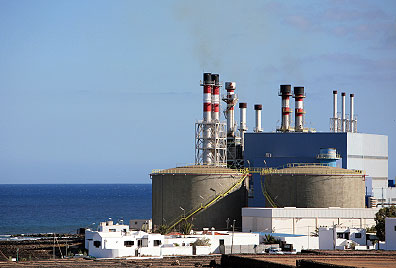
The vast majority of desalination plants in the world employ a process called reverse osmosis. Either ocean water or brackish water is pushed through a series of membranes at very high pressure, effectively separating water from other elements.
Most companies looking to get into the desalination space, which is all but guaranteed to grow over the next several years, concentrate on the membrane, researching advanced materials that can help to chemically strip water from other elements and thus reduce the pressure requirements for the water coming through the membranes, which in turn reduces the energy requirements of the process.
According to the Encyclopedia of Desalination and Water Resources, the theoretical minimum amount of energy required to desalinate a cubic meter of water is .86 kWh, but the actual energy required in plants throughout the world is five to 26 times that. The theoretical minimum calculates only the energy required to separate water from other elements, not the power required to keep a plant running in general.
That’s where the solar power comes in.
Desalination plants and solar energy are a natural fit: More often than not, areas with water shortages also tend to be areas where there’s quite a bit of sun. At the IBM/KAST Saudi Arabia plant, a solar concentrator system will capture energy equivalent to 1,500 suns, according to IBM, powering a plant that will produce 30,000 cubic meters per day of fresh water for a city of 100,000 people.
So why haven’t solar-powered desal plants been popping up all over the world?
“Solar is still not at grid parity, and if you’re going to build a solar system into a desalination plant, you also need a back-up system in case of cloudy days or dust storms, and all of that is a large additional cost to building a plant,” explains Nunes.
Part of what reduces the cost of solar in this case, according to Nunes, is a proprietary cooling technology that cuts down on system outages and maintenance issues. The liquid metal interface of the system, a technology that grew out of IBM’s experience with mainframe computers and chip manufacturing, enables very high cooling rates, according to Nunes, and thus more intense energy capture.
“Usually, the more energy capture, the hotter your solar cell gets, and we’re talking about really extreme temperatures, which means you end up with unreliable chips or you burn out your chips entirely, so cooling these systems is very important,” she said.
High-Tech Membranes Increase Efficiency
According to Nunes, the membranes employed at the Saudi desalination plant will help reduce the plant’s energy requirements.
The membrane includes fluorine, which is naturally hydrophobic, but at an adjusted pH that makes it hydrophilic. In layman’s terms, through the magic of chemistry, a material that usually repels water now attracts it, which makes it a very effective membrane with which to desalinate water. The material also is resistant to chlorine, which is often used to pre-treat water in purification systems but typically degrades membranes.
The membrane is also more resistant to fouling than other membranes on the market, according to Nunes. The sand, shells, weeds and small sea creatures that can get stuck on membranes means they need to be cleaned fairly often, and when the membranes are at their dirtiest, more energy is required to push water through them at a higher pressure.
Which gets to the other aspects of desalination that environmentalists don’t particularly like, aspects that IBM’s technology isn’t yet focused on: loss of biodiversity in some marine areas and the effect of the briny effluent produced by the desalination process, which is generally dumped back into the original water source.
Concerns for Biodiversity
The brine (a highly salty water that’s 10 times saltier than average ocean water) produced by desalination plants has been tested in labs and shown to have little effect on marine life, but the argument from some marine biologists is that in a lab test, fish and other sea life can’t get away; while the brine may not kill them, in a real-world scenario they may opt to just leave an area that is suddenly 10 times saltier than it used to be.
The loss of biodiversity is an issue that has largely been pooh-poohed by desalination proponents. There are currently more than 12,000 desalination plants in the world, and as that number grows, it could have a drastic effect on marine ecosystems as the smallest organisms are routinely sucked into a pump and crushed against membranes.
The current focus on improving energy and water efficiency in desalination plants is a positive one, and replacing coal-powered desalination with solar-powered desalination is imperative, otherwise the “solution” to the water problem is helping to exacerbate one of the causes: climate change.
But the idea of efficiency needs to be more broadly applied to the water problem as a whole. One of the reasons that fresh water is at a premium is that much of it has been polluted. In some cases, that renders the water completely undrinkable; in others, in order to drink it, the fresh water needs to be purified in much the same way that saltwater needs to be desalinated, and that process is also energy intensive.
Purification processes need to become more efficient, fresh water stores need to be better protected and technologies that help people use less water and use it more efficiently are still desperately needed. As is the case with energy, solutions to the water shortage need to look at efficiency first and then filling in with “new” water where nothing more can be done on the efficiency front.
As a researcher at the Pacific Institute studying the pros and cons of desalination once put it to me, if you’ve got a leaky bucket, what’s the more logical solution, to just add more water or to plug the holes?
See also:
Veolia Hits the Accelerator for Cleantech, Calls for Startups to Jump On
Solar Power From Africa: The Best Investment the EU Can Make
Climate Change Could Bring Water Bankruptcy With Grave Consequences
About This Story
Perhaps you noticed: This story, like all the news we publish, is free to read. That’s because Inside Climate News is a 501c3 nonprofit organization. We do not charge a subscription fee, lock our news behind a paywall, or clutter our website with ads. We make our news on climate and the environment freely available to you and anyone who wants it.
That’s not all. We also share our news for free with scores of other media organizations around the country. Many of them can’t afford to do environmental journalism of their own. We’ve built bureaus from coast to coast to report local stories, collaborate with local newsrooms and co-publish articles so that this vital work is shared as widely as possible.
Two of us launched ICN in 2007. Six years later we earned a Pulitzer Prize for National Reporting, and now we run the oldest and largest dedicated climate newsroom in the nation. We tell the story in all its complexity. We hold polluters accountable. We expose environmental injustice. We debunk misinformation. We scrutinize solutions and inspire action.
Donations from readers like you fund every aspect of what we do. If you don’t already, will you support our ongoing work, our reporting on the biggest crisis facing our planet, and help us reach even more readers in more places?
Please take a moment to make a tax-deductible donation. Every one of them makes a difference.
Thank you,