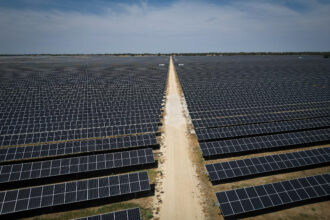
Italy is in the midst of a solar surge, outpacing the United States and coming in second only to solar powerhouse Germany in the push to install new projects.
The Mediterranean country’s solar boom is likely to continue for the next several years, thanks to recently adopted changes to its feed-in tariff scheme and a new national authorization process for solar projects. In the meantime, the U.S. solar industry says implementing similar policies stateside could propel domestic solar growth, and federal, state and municipal lawmakers are pushing to get such rules on the books.
In the second quarter of 2010, Italy’s solar market grew by 127 percent over the previous quarter, according to research and consulting firm Solarbuzz. That means it is on track to reach its goal of doubling its solar capacity in 2010, aiming for a total installed capacity of about 2,500 megawatts (MW). In the longer term, the country hopes to have 8,000 MW installed by 2020.
“We forecast a sustained growth path, thanks to the stable government support to the development of renewable energies and to the establishment of a solid and highly professional market of solar PV market operators," David Armanini, managing director of Italian solar developer Prothea, told SolveClimate News in an e-mail. "We are confident that the market will show an annual growth of about 1.5 gigawatts in the next three years.”
Prothea, which develops rooftop and greenfield solar photovoltaic projects, recently completed the authorization process for four solar projects totaling 11 megawatts, and has more than 50 megawatts worth of projects in its development pipeline. The company says the country’s feed-in tariff scheme and expected cost reductions for solar materials are supporting its growth, while a pending move to establish national guidelines for authorizing solar projects could speed development timelines.
Like other European countries, notably Spain and Germany, Italy’s solar growth has been fueled largely by its feed-in tariff scheme, which was implemented in its current incarnation in 2007. Feed-in tariffs encourage investment in solar development by providing renewable power producers with a long-term guarantee to purchase the power they generate.
But in the face of concerns that its solar sector was over-subsidized and in an effort to reduce energy bills, Germany plans to reduce its feed-in tariffs by about 15 percent this year. Italy is taking a different tack. While it is also cutting back its tariffs, it plans to do so gradually, which would continue to drive its solar sector’s sharp growth trajectory in the short term.
“The Italian market will be the leading market in the next years, at least for the next two,” Armanini said.
This summer Italy revealed its new feed-in tariff scheme, called the Third Conto Energia. The new plan would reduce feed-in tariffs by about 20 percent in 2011, but would do so incrementally, implementing cuts every four months. The new tariffs would apply to plants that begin operating between 2011 and 2013.
Last summer Italy also unveiled a plan establishing national guidelines for project authorization, in an attempt to address a patchwork of regional processes and streamline the development process.
“The government policies show a clear support for the sector, particularly after the approval of the Third Conto Energia. The most important hindering factor to the development of solar PV was regional and local differences on the authorization path for power plant construction,” Armanini said.
In the U.S., renewable energy advocates say feed-in tariffs could drive clean energy development domestically. Several states, including Vermont, Washington and Hawaii, are weighing feed-in tariff options, while municipal utilities in Sacramento and Gainesville, Fla., have implemented them. On the federal level, Rep. Jay Inslee (D-Wash.) in July introduced legislation that included a federal feed-in tariff.
In California, the state’s Public Utilities Commission in August issued a proposal to launch a program that supporters say would incentivize renewable energy development, while addressing the challenge of setting long term power prices in a constantly fluctuating market, something which has plagued European feed-in tariff schemes.
Called the Renewable Auction Mechanism feed-in tariff model, the 1-gigawatt pilot program would require California utilities to buy power from renewable systems of between 1 and 20 MW in size. The state’s investor-owned utilities would hold biannual auctions for renewable energy developers, and award contracts to the lowest-cost, viable projects.
The auction model would ensure that prices would not be set too low to encourage participation in the program, nor too high, which could drive up costs for ratepayers, according to The Vote Solar Initiative, a California nonprofit targeting policies to boost renewable energy development.
“What they learned [in Europe] is that it’s hard to peg a price in a competitive market, especially when the price of panels fluctuates,” said David Niebauer, founding partner of Energy Council Partners, a San Francisco-based law firm focused on renewable energy.
“The approach the CPUC is taking is more sustainable.”
(Photo: NASA)
See Also
Breakthrough Solar Plant Stores Energy for Days
Yet Another Spanish Firm to Harvest Solar in Southwestern U.S.
Thousands of Jobs Riding on Extension of Clean Energy Cash Grant Program
Evolution Solar: China Now ‘Center of Gravity’ for Solar Manufacturing
Solar Could Generate 15% of Power by 2020, If US Ends Fossil Fuel Subsidies
About This Story
Perhaps you noticed: This story, like all the news we publish, is free to read. That’s because Inside Climate News is a 501c3 nonprofit organization. We do not charge a subscription fee, lock our news behind a paywall, or clutter our website with ads. We make our news on climate and the environment freely available to you and anyone who wants it.
That’s not all. We also share our news for free with scores of other media organizations around the country. Many of them can’t afford to do environmental journalism of their own. We’ve built bureaus from coast to coast to report local stories, collaborate with local newsrooms and co-publish articles so that this vital work is shared as widely as possible.
Two of us launched ICN in 2007. Six years later we earned a Pulitzer Prize for National Reporting, and now we run the oldest and largest dedicated climate newsroom in the nation. We tell the story in all its complexity. We hold polluters accountable. We expose environmental injustice. We debunk misinformation. We scrutinize solutions and inspire action.
Donations from readers like you fund every aspect of what we do. If you don’t already, will you support our ongoing work, our reporting on the biggest crisis facing our planet, and help us reach even more readers in more places?
Please take a moment to make a tax-deductible donation. Every one of them makes a difference.
Thank you,