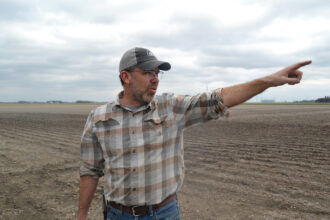
WASHINGTON—His climatology career at Ohio State University is advancing swimmingly. He’s never had a brush with the law. And his wife is eight months pregnant with their first child.
So staying home for the next several weeks in Columbus, Ohio, rather than risking arrest in the nation’s capital certainly seems the ideal choice for professor Jason Box.
But the 38-year-old has never reveled in the idea of an intellectual or physical comfort zone.
His natural inquisitiveness — plus a dose of idealism and commitment — is why Box is intent on participating in his first-ever act of civil disobedience. The cause? Trying to convince President Obama that approving the extension of a controversial oil sands pipeline — the proposed $7 billion, 1,702-mile Keystone XL — would be the equivalent of lighting a fuse to the biggest carbon bomb on the planet.
It’s not a single-handed effort on Box’s part. But as of mid-week he’s evidently the only climate scientist who has registered to join about 2,000 other like-minded thinkers to line the fences surrounding the White House — where peaceful arrests are not uncommon for protesters of all stripes.
They’ll begin gathering Saturday and rotate through in waves of 75 to 100 daily through Sept. 3. Box is booked for a three-day stint at the tail end.
“I couldn’t maintain my self-respect if I didn’t go,” Box said Tuesday in a telephone interview about his decision to wade into the murky territory of activism where most scientists fear to tread. “This isn’t about me, this is about the future. Just voting doesn’t seem to be enough in this case. I need to be a citizen also, because this is a democracy after all, isn’t it?”
Bill McKibben, the activist, author and Middlebury College professor who founded the advocacy organization 350.org is the instigator of the summer sit-in. Back in June, he collaborated with 10 Canadian and American climate-concerned luminaries — including author and farmer Wendell Berry and actor Danny Glover — to circulate a three-page plea for support.
Earlier this month, Box and 19 other prominent U.S. scientists fired off a letter to the White House urging Obama to reject Alberta-based TransCanada’s plans to construct Keystone XL. Among the marquee authors are James Hansen of Columbia University’s Earth Institute and Michael Mann, director of the Earth System Science Center at Pennsylvania State University.
Although Hansen hasn’t signed up for the event, he’s expected to appear at 1600 Pennsylvania Ave. late in August. He has been arrested several times in the past for protesting mountaintop removal mining. Mann, on the other hand, tends to shy away from protests. At the end of 2009, his research was targeted by global warming deniers in a bizarre and trying episode known as “Climategate.” He was cleared of any wrongdoing.
“The tar sands are a huge pool of carbon, but one that does not make sense to exploit,” the scientists wrote to Obama. “When other huge oil fields or coal mines were opened in the past, we knew much less about the damage that the carbon they contained would do to the Earth’s climate system and to its oceans.
“Now that we do know, it’s imperative that we move quickly to alternate forms of energy,” they continued. “As scientists, speaking for ourselves and not for any of our institutions, we can say categorically that [the pipeline is] not only not in the national interest, it’s also not in the planet’s best interest.”
The Science Is Complete
Until now, Box’s career path has been that of the quintessential non-partisan scientist. A Colorado native who speaks in careful, measured sentences, he doesn’t take his decision to travel to Washington, D.C., for his inaugural climate protest lightly. As part of his preparations he has sought advice from an Ohio State media expert, who had a wealth of insight on how scientists-cum-activists are potential lightning rods in the climate debate.
As a freshman at the University of Colorado-Boulder in 1990-91 Box was vacillating between geology and astronomy. But reading the first assessment by the Intergovernmental Panel on Climate Change (IPCC) of the United Nations convinced him to laser in on geography and climatology. That report documented the toll carbon dioxide and other greenhouse gases were having on Earth.
As an undergraduate, he became one of the youngest protégés of Konrad Steffen, a world-renowned climate scientist performing cutting-edge research on the glaciers of Greenland. Twelve years and five academic degrees later — all earned in Boulder — Box headed to Ohio State. He’s a tenured associate geography professor and research scientist at the university’s Byrd Polar Research Center.
Strenuous pilgrimages to the Greenland ice sheet — his accumulated study time on inland ice now exceeds a year — have made him an authority on the relationship between Greenland’s glaciers and the Arctic’s warming climate. Strategically placed cameras have allowed him to precisely measure how much ice is permanently disappearing.
Box’s innovations have earned him accolades and recognition from the National Oceanic and Atmospheric Administration, the American Meteorological Society, the American Geophysical Union and other organizations that value drive, curiosity and critical thinking. He was also invited to be a contributing author to the IPCC’s most recent 2007 report on the causes and consequences of climate change. That same year the panel won the Nobel Peace Prize, which it shared with former Vice President Al Gore.
Climate scientists have already done their homework, Box emphasized, adding that the results are irrefutable. Report after exhaustive report repeat the warning that humans are contributing to their own demise by continuing to warm the planet by emitting heat-trapping gases, he said.
Treading Academic Water Long Enough
Box sees no reason why he can’t maintain his professional scientific credibility while making a foray into activism.
He said some of his fellow scientists already have complimented him for signing the letter and for deciding to travel to the Washington protest. His impression is that he won’t be shunned by a community that’s becoming more vocal about its convictions.
“OK, so what’s next is what I keep asking myself,” Box said about his evolution as a scientist. “I’ve achieved what I set out to do with climatology. Am I just going to just keep studying the melting ice in Greenland? Then I’d just be treading water instead of swimming.”
By participating in the protest, he might liberate other climate scientists to take a stand, he said. If Hansen, who has fashioned a distinguished career with the National Aeronautics and Space Administration, can lead such a charge among the older guard, Box figures he might be an inspiration for mid-career scientists with potentially more to lose.
Still, Box struggles with that longtime inner voice that tells scientists not to take sides, utter opinions or wave around signs with pithy messages as activists do at rallies.
Yes, he admits to being a bit apprehensive about being confronted by climate deniers who might accuse him of being part of a vast Al Gore conspiracy. But he’s not worried enough to cancel his September flight.
“If our elected leaders aren’t acting, then we’re going to have to get more involved with our democracy,” he said. “This is about motivating decision-makers to do their job. I’d like to think that scientists engaging skillfully with words and reason could start to change this problem … This is a moral movement and a moral issue. It’s unethical for us to stand by while the greed of others results in the destruction of our biosphere.
“I feel I’m on the high ground defending this position and that I have reason on my side,” he continued. “The question is, will anybody listen?”
A year or so ago, very few observers would have predicted that the Keystone XL pipeline — which has the potential to double, or perhaps triple the amount of diluted bitumen flowing to this country from its northern neighbor — would dominate climate activists’ agenda and galvanize the movement.
But Box said that mining the oil sands would boost North America’s carbon footprint so dramatically that it is the perfect centerpiece for the complex struggle over global warming.
“If Obama authorizes this pipeline, it will prove that the power of oil is greater than the power of reason,” Box said. “He cares about this issue and he tells us he wants the country to run on clean energy. Does he cave in? We shall see.”
Giving Up Not an Option
Although Obama will be vacationing on Martha’s Vineyard for part of the time activists from across the nation will be holding court near the White House, Box predicts the protest’s peaceful strategy will be effective.
“I’m convinced that a non-violent approach will work,” Box said. “If it gets Obama’s attention it will have accomplished more than the next snazzy article appearing on the cover of a major scientific journal.”
Lessons from his earliest geography classes reinforced how vital it is to always connect the dots to the human element.
“Sure, it’s fascinating to study Arctic ice,” he said. “But when what happens in the Arctic is felt throughout the world and the science is relevant to human livelihoods we owe it to ourselves to act.”
While Box is savvy enough to know that much of the climate debate has been hijacked by extremists more intrigued with hyperbole than facts, he is optimistic enough to hope that a peaceful demonstration can prompt rational thinking.
“I want to believe that reason will prevail here,” he said, adding that both science and survival are about devising solutions. “I’ve learned you never give up. That’s how I’ve been successful so far.”
About This Story
Perhaps you noticed: This story, like all the news we publish, is free to read. That’s because Inside Climate News is a 501c3 nonprofit organization. We do not charge a subscription fee, lock our news behind a paywall, or clutter our website with ads. We make our news on climate and the environment freely available to you and anyone who wants it.
That’s not all. We also share our news for free with scores of other media organizations around the country. Many of them can’t afford to do environmental journalism of their own. We’ve built bureaus from coast to coast to report local stories, collaborate with local newsrooms and co-publish articles so that this vital work is shared as widely as possible.
Two of us launched ICN in 2007. Six years later we earned a Pulitzer Prize for National Reporting, and now we run the oldest and largest dedicated climate newsroom in the nation. We tell the story in all its complexity. We hold polluters accountable. We expose environmental injustice. We debunk misinformation. We scrutinize solutions and inspire action.
Donations from readers like you fund every aspect of what we do. If you don’t already, will you support our ongoing work, our reporting on the biggest crisis facing our planet, and help us reach even more readers in more places?
Please take a moment to make a tax-deductible donation. Every one of them makes a difference.
Thank you,